Our Location
Call Us
Send a Mail
Working hours
9-6 PM Monday to Saturday
9-6 PM Monday to Saturday
A bright, white smile is one of the most powerful confidence boosters. At Tooth & Go Dental Clinic in Bf Homes/Parañaque, we offer professional teeth whitening procedures designed to lighten discoloration, and restore your natural tooth shade—or make it even brighter than before.
Our treatments use dentist-supervised peroxide-based whitening systems, ensuring both safety and long-lasting results.
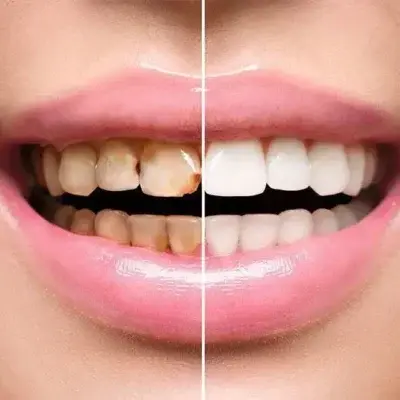
Tooth color bleaching is mainly determined by the dentin (the inner layer) rather than the enamel (the outer layer).
External or internal factors can cause discoloration.
These stains affect the outer enamel surface and are caused by everyday exposure to pigments such as:
These stains respond well to professional whitening.

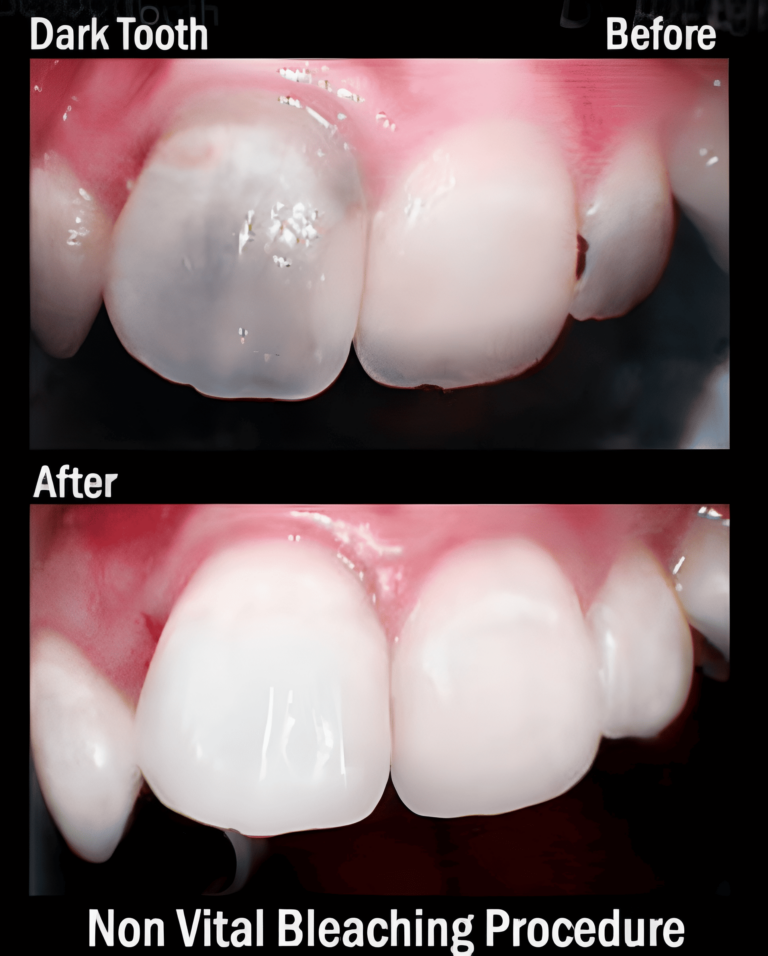
These stains occur inside the tooth structure:
Intrinsic stains often require a more extended bleaching period, which can last up to 6 months of daily bleaching (Tetracycline), usually combined with resin infiltration (Icon), and is performed only by a dentist.
Tooth bleaching is a decolouration process in a solution or on a surface.
The literature suggests that tooth bleaching occurs by diffusion through enamel, causing oxidation and, therefore, the whitening of organic pigments or chromogens, particularly in dentin (1).
There are three main ways to whiten teeth safely:
OTC kits or online bleaching products are not recommended. Your dentist should provide and check all products you use. Bleaching with unfavorable formulas can be harmful to you. They might contain unfavorable ingredients, such as excessive hydrogen peroxide, or lack essential ingredients, such as potassium nitrate, which serves as a desensitizer.

Ideal for patients who want instant results
This option is slightly more expensive due to chair time; but, it is performed entirely under a dentist’s supervision.
What to expect:
You leave the clinic the same day with noticeably brighter teeth.
Please be aware that, due to tooth dehydration, teeth may appear slightly whiter than their final shade after light-activated bleaching. This false whiteness returns after a few days (rehydration phase).
Ideal for: dark teeth that had previous root canal treatment
A single tooth may darken after trauma or endodontic therapy due to blood pigments or necrotic remnants inside the tooth.
How it works:
This technique can whiten a previously dark tooth without a crown
After an in-office procedure—or as a stand-alone option—your dentist may provide:
Home whitening works well; it stays active for up to 10 hours in a tray(50% after 2 hours, 10% after 10 hours). It usually takes 1–2 weeks with a lower-concentration bleaching agent (10%, 15%, 20%, or 35%) and provides gradual tooth bleaching.
Newer bleaching gels contain(2):
Brands like Ultradent pioneered these improved formulations, offering predictable and gentle whitening without the need for light activation.
Most patients enjoy results that last several months, depending on lifestyle. Nevertheless, ups are recommended every 6-12 months to maintain the exact shade that was achieved initially after bleaching.
Most patients enjoy results that last several months, depending on lifestyle. Nevertheless, ups are recommended every 6-12 months to maintain the exact shade that was achieved initially after bleaching.
Yes—when performed by a dental specialist.
Professional whitening materials, such as Ultradent products, have a neutral pH, are controlled and predictable, and are scientifically tested.
Common temporary effects may include mild sensitivity, which can be minimized by potassium nitrate, a common ingredient of bleaching materials.
Whitening is not recommended for:
Costs vary depending on the whitening system used. Please check prices here for detailed pricing.
In case of improper application of bleaching material, specifically overheating of the teeth, thetooth substance as wwell the nerve(ov erheating during liglight-activatedhing) can be damaged.
If bleaching materials are applied correctly, they don’t harm the tooth or tooth substance. They even strengthen the enamel due to the fluoride content in modern bleaching materials(Ultradent).
Most patients achieve 2–8 shades lighter, depending on stain type and enamel structure. Nevertheless, the success of bleaching is closely related to individual and genetic factors of dentine.
No-only natural tooth structure responds to bleaching.
In-office whitening takes 30–90 minutes. Home whitening on the weeks.
(1) Sulieman M. An overview of bleaching techniques: I. History, chemistry, safety, and legal aspects. Dent Update. 2004 Dec;31(10):608-10, 612-4, 616. doi: 10.12968/denu.2004.31.10.608. PMID: 15656076.
https://pubmed.ncbi.nlm.nih.gov/15656076/
(2) An overview: insight into dental bleaching agents JMPAS
https://jmpas.com › admin › assets › article_issue
SV Shinde
(3) Is Resin Infiltration a Microinvasive Approach to White Lesions of Calcified Tooth Structures?: A Systemic Review
Vidya Manoharan 1,✉, S Arun Kumar 2, Selva B Arumugam 3, Vijay Anand 4, Santham Krishnamoorthy 5, John J Methippara 6
https://pmc.ncbi.nlm.nih.gov/articles/PMC6710943/
Written by:
Dr. Jens Knab,
(Dental Approbation Rheinland Pfalz, Germany)
DMD, MSc Implantology
Master of Science in Dental Implantology (Uni Camillus, Italy)
Founder, Tooth & Go Dental Clinic, Parañaque